
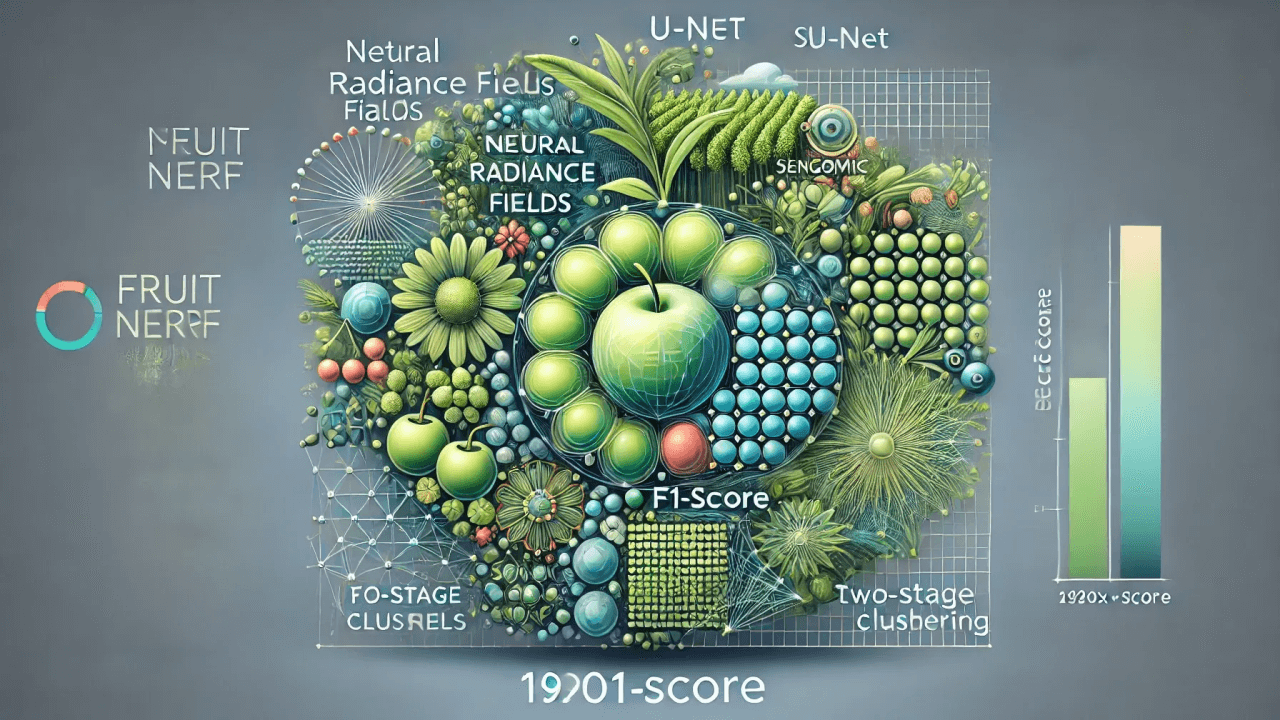
FruitNeRF: Revolutionizing Fruit Counting with Neural Radiance Fields
How can we accurately count different types of fruits in complex environments using 3D models derived from 2D images without requiring fruit-specific adjustments?
The FruitNeRF framework is a significant innovation in precision agriculture, providing a robust solution for accurate fruit counting. Using Neural Radiance Fields (NeRF), FruitNeRF constructs 3D models from 2D images, enabling precise fruit counting across various environments and types. The framework's use of Semantic NeRF*, U-Net models**, and a two-stage clustering approach ensures high accuracy and generalization with minimal manual intervention.
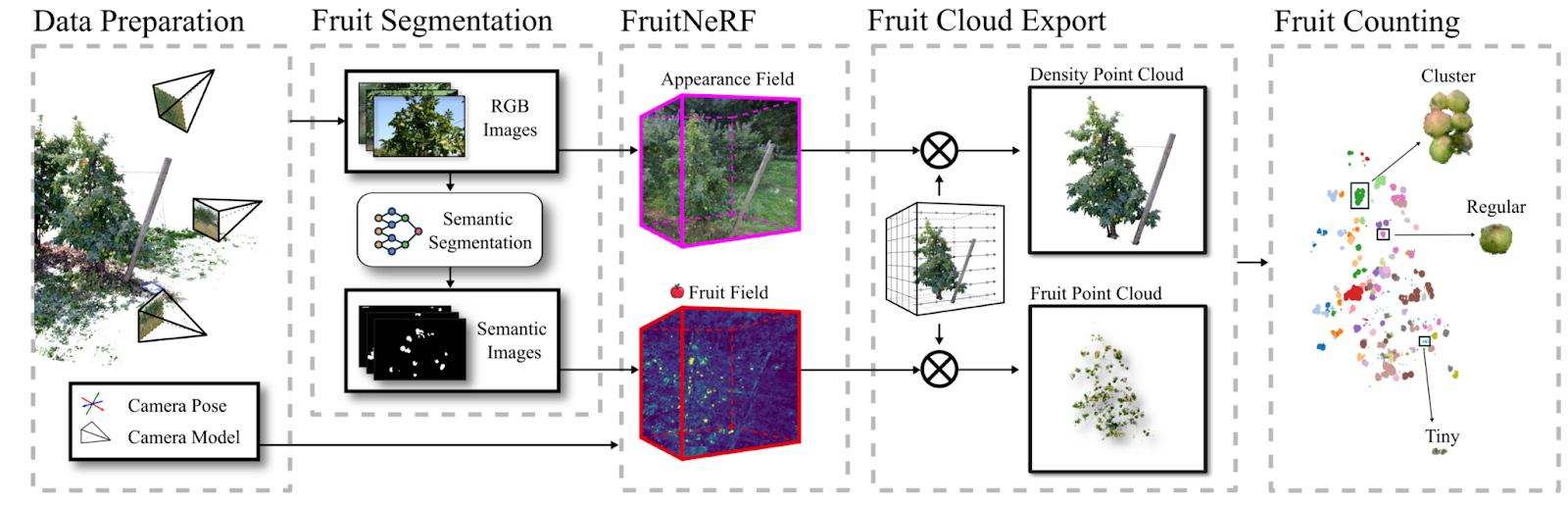
*Semantic NeRF refers to a method that integrates semantic segmentation into Neural Radiance Fields (NeRF), enhancing the ability to understand and represent scenes more meaningfully. This approach is characterized by its dual projection heads that simultaneously predict semantic labels and color information, allowing for a richer understanding of the scene's geometry and semantics.
**U-Net is a convolutional neural network architecture primarily designed for semantic segmentation tasks, particularly in biomedical image analysis. Developed in 2015 by Olaf Ronneberger and colleagues, U-Net has become a standard model due to its efficiency in handling limited training data while achieving high accuracy

With increasingly demanding consumers, developing a successful product requires more than just knowing about the product itself. You need to understand business, people, technology, design, and… a little bit of everything.

Explore the top free and paid AI tools for 2025, including the best AI chatbots, image and video generators, research assistants, and productivity apps. Compare features, pricing, and top picks for creative and professional use.

"Vibe Coding" is a form of programming where developers interact with code in a conceptual, AI-assisted manner, rather than manually writing each line.
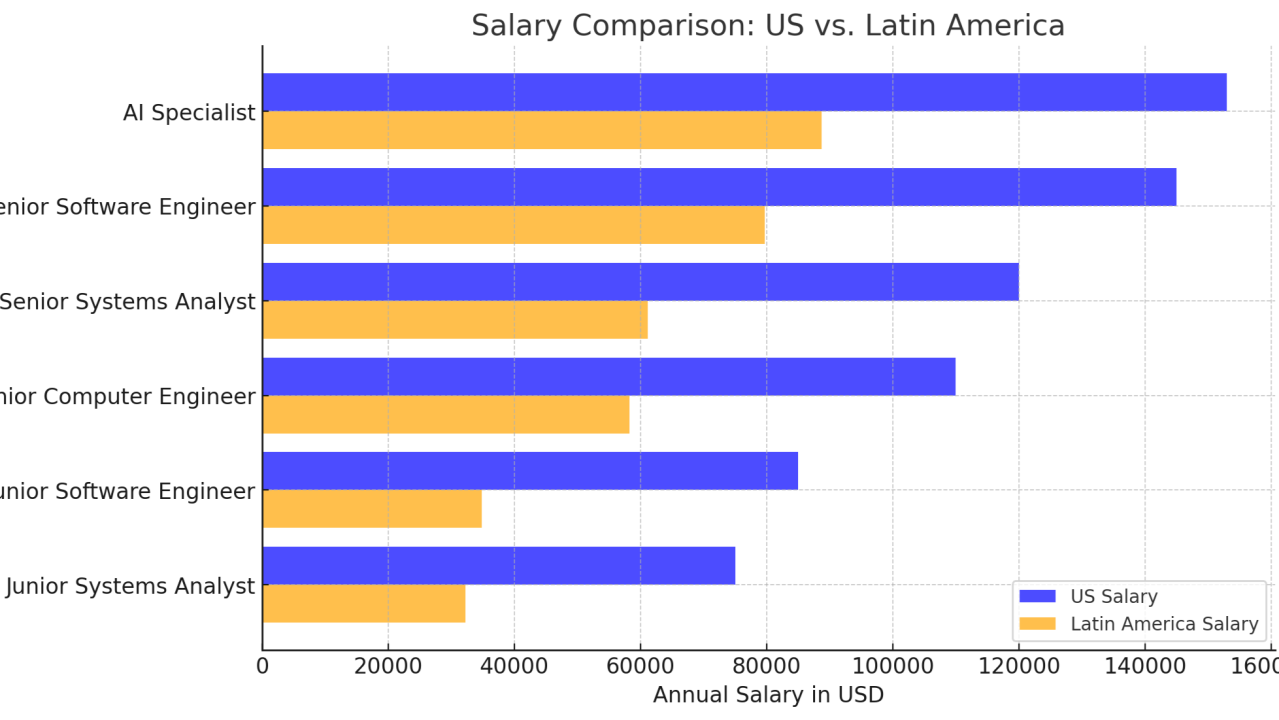
The shortage of technology professionals, including programmers, engineers, and analysts, has intensified in the United States due to the increasing demand for specialized skills and a limited supply of qualified talent.

The need arise from the need to streamline the analysis of exams performed on patients who may present detectable pathologies through imaging studies, assisting the physician in making a faster and more accurate diagnosis.
Researchers at Sakana.AI, a Tokyo-based company, have worked on developing a large language model (LLM) designed specifically for scientific research.